What an element replacement usually costs
Short answer: about $200 to $300. In published cost guides, a professional heating element replacement on an electric water heater typically runs in that range. These are typical US ranges from published cost guides, not a Lynn Haven quote. The part itself is inexpensive, so most of that figure is labor and the service call.
The same guides put a thermostat replacement at roughly $150 to $200, with the part around $20. Angi lists a national average of about $603 for water heater repairs overall, with most jobs landing between $90 and $1,750. A wide spread like that tells you the element is the cheap end of the scale and a leaking tank is the expensive end.
| Repair | Typical US range | What drives the price |
|---|---|---|
| Heating element | $200 to $300. | Upper or lower element, stuck old element, draining the tank. |
| Thermostat | $150 to $200. | Upper or lower, high-limit reset, wiring condition. |
| Elements plus thermostats. | Adds up quickly. | Age of the tank, corroded wiring, sediment load. |
| Tank leak | Repair is not possible. | Replacement is the usual answer. |
Is it the element, the thermostat, or the tank?
A standard electric tank has two elements, one near the top and one near the bottom, each with its own thermostat. If the top element dies, you get no hot water at all or very little. If only the bottom element fails, you get a short burst of hot water that runs out fast.
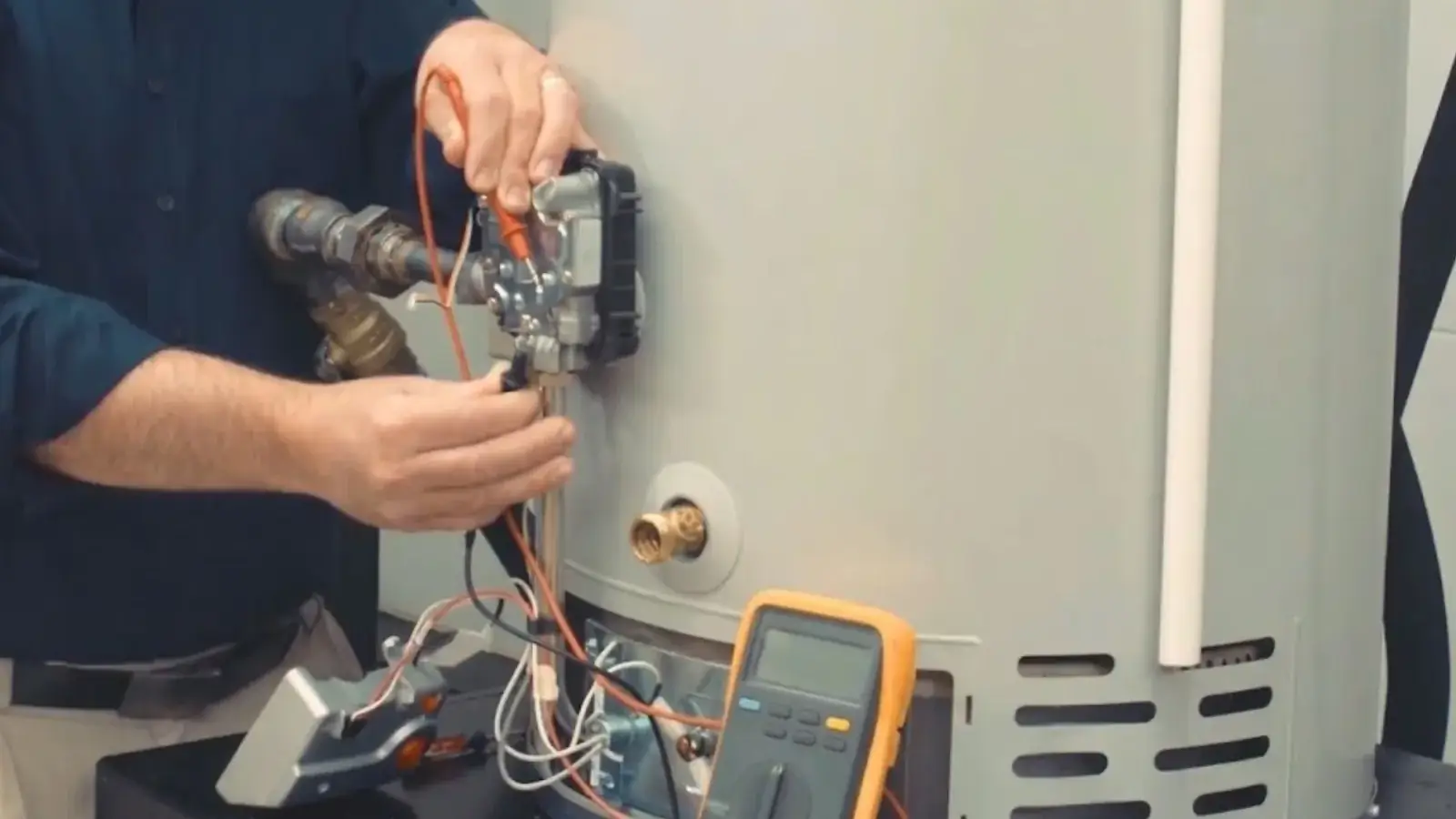
Spending money on the wrong part is the common mistake. A burned-out element and a tripped high-limit reset can look the same from the shower. A plumber checks power at the terminals with a multimeter and tests the element for continuity before ordering anything.
- Breaker tripped or fuse blown: reset once only, since a repeat trip points to a shorted element or bad wiring.
- Water hot for a few minutes, then cold: usually the lower element or its thermostat.
- No hot water, breaker fine: usually the upper element, upper thermostat, or the red high-limit reset button.
- Water that is hot but noisy and rumbling: sediment on the elements, which shortens their life.
- Water pooling at the base: stop and call, because a leaking tank cannot be fixed by an element swap.
Want a real number for your tank?
Prices depend on the model and the tank's condition. Call the 24/7 line and describe what the water is doing.
What a replacement visit involves
Power off and verify
The plumber turns off the breaker, then confirms with a tester that the terminals are dead before touching anything.
Drain below the element
The tank is drained partway so the element can come out without a flood. A stuck drain valve can add time.
Pull the old element
A special element wrench breaks the old one loose. Heavy scale can lock it in place and make this the hardest part.
Fit the new element and gasket
The new element must match the voltage and wattage printed on the tank's rating plate. A wrong match can overheat or underperform.
Refill before powering up
The tank must be completely full before the breaker goes back on. Power to a dry element burns it out in seconds.
What raises or lowers the bill
Access matters first. A water heater in an open garage is quick to reach, while one in a tight closet or attic takes longer. Tanks with a failed drain valve, corroded wiring, or a thick layer of sediment take more time and sometimes more parts.
Age matters second. Tanks often last about 8 to 12 years, so an element swap on a tank near the end of that window is a judgment call. If the tank is old and the anode rod is likely spent, pairing the repair with a look at water heater replacement can save a second visit.
Insurance rarely covers this job. A burned-out element is ordinary wear, not sudden damage, so check your policy before assuming otherwise.
Lynn Haven water and your elements
The City of Lynn Haven runs its own water system. Per the city's 2024 Annual Water Quality Report, five deep wells in the Floridan Aquifer serve most customers, and the rest receive surface water bought from Bay County Utilities. The report lists a 2024 chlorine residual average of 1.5 ppm.
That same report does not list hardness, so test your own tap rather than assume. Hardness matters because mineral scale bakes onto elements and lowers their lifespan. A cheap test strip or a lab test tells you whether flushing the tank yearly is worth the effort in your house.
Flush, check, or replace: a quick decision guide
Use this as a starting point, not a diagnosis. If the symptom matches more than one row, an in-person test settles it.
| What you see | Likely cause | Next step |
|---|---|---|
| Lukewarm all day. | Failed lower element. | Test and replace the element. |
| Nothing hot, breaker on. | Upper element or high-limit trip. | Press reset once, then call. |
| Rumbling and popping. | Sediment on elements. | Flush the tank, then retest. |
| Rust-colored hot water. | Corroding tank | Plan for a new heater. |
| Water around base. | Tank or fitting leak. | Shut off water and power, call. |
If the tank is gas rather than electric, none of this applies because gas units have no element. For a gas smell, leave the building and call 911 or the gas utility before you call a plumber.
Nearby towns we cover for this repair
The same electric tank problems show up across the county. Homeowners in Callaway and Parker call the same 24/7 line, and a dispatcher can tell you whether a repair visit makes sense for your tank's age.
Before you hire anyone, you can verify a Florida plumbing contractor's license at MyFloridaLicense.com by searching the business name or license number.
Frequently asked questions
Published cost guides put professional replacement at roughly $200 to $300 in typical US ranges, not a Lynn Haven quote. The part is cheap, so labor, access, and a stuck old element drive the total.
Some homeowners do, but it involves 240-volt power and a full drain. If you do it, shut off the breaker, test the terminals with a meter, and never power the heater until the tank is full. A licensed plumber is the safer path if any of those steps feels uncertain.
There is no fixed number. Scale, water chemistry, and how often the tank cycles all change it. A noisy, rumbling tank usually means sediment is shortening element life.
Often a plumber will test both. If the tank is mid-life and the second element is scaled over, doing both in one visit can save a second service charge.
No. The city's annual water quality report does not list hardness, so a tap test is the way to find out. A test result helps you decide how often to flush the tank.